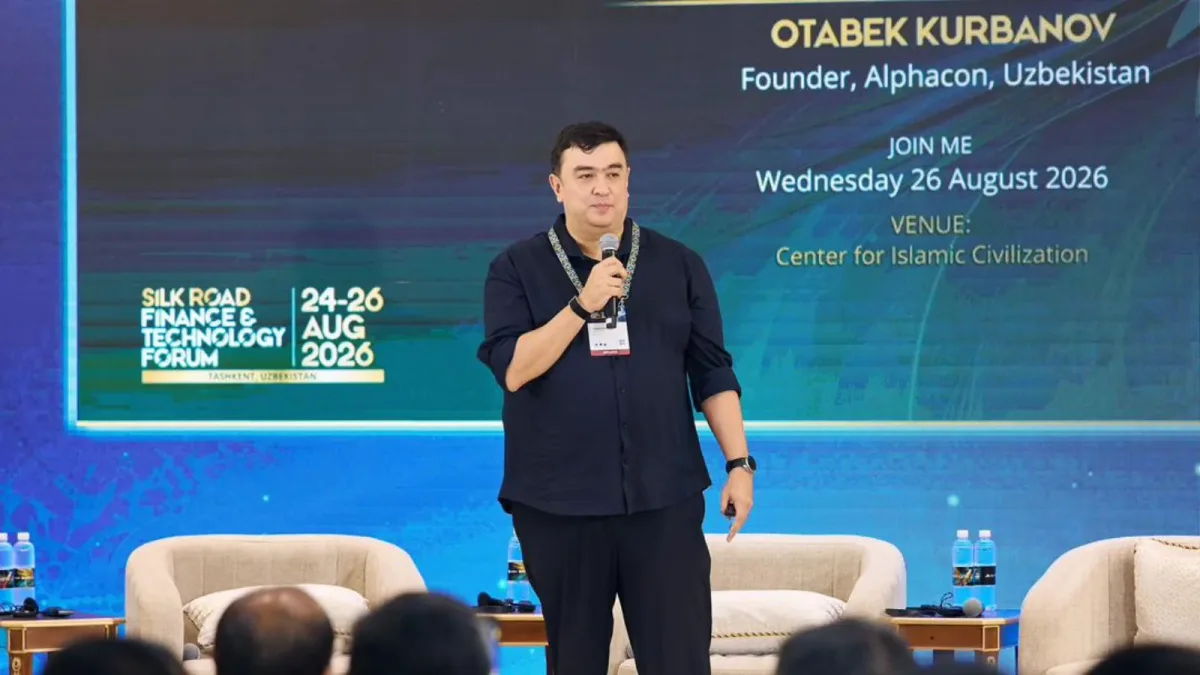
FROM CORPORATE EXECUTIVE TO FOUNDER
Some founder stories begin with an idea. Others begin with a decision to leave behind a system that has worked for years.
For Otabek Kurbanov, Founder & CEO of Alphacon, that decision came after around two decades in the corporate world, including experience with companies that played an important role in shaping Uzbekistan’s fintech ecosystem, such as CLICK, Uzum and UZCARD.
In 2024, he moved from executive to entrepreneur and found himself facing a different reality. There was no longer a large organisation behind his decisions, no one above him to escalate a problem to, and no corporate system to absorb the risk.
Today, Alphacon is being built around an approach that puts customers, distribution, sales and real transactions before automation and scale.
In this conversation, Otabek speaks about the transition from corporate life to entrepreneurship, building Alphacon, sales, responsibility, trust, distribution, the realities of entering Uzbekistan and how his definition of success has changed.
- You once described yourself very simply: “43 years old. 20 years in corporations. Now a startup founder.” What did that transition actually feel like?
After two decades inside established companies, the decisions, risks and responsibility suddenly became entirely yours. What was the hardest part of moving from a senior executive role to becoming a founder?
I wasn’t surprised by the workload, or the uncertainty since I already knew how to work hard and how to deal with unknowns. The biggest change for me was that all of a sudden there was no one left to escalate to.
In a corporation, you may be responsible for a huge business, large teams and significant budgets, but there is still a company behind you. You have shareholders, a board, a CEO, a brand, a capital, an entire support network that leverages and hedges your every move.
When you are a founder, there is nobody above you. If you are running out of money or if the strategy is wrong, or the tactics are misaligned these problems are yours and yours only. People who believed in me and joined the company look up to me for solutions. That was the moment when I truly understood that the responsibility of an executive and the responsibility of an owner are two very different things.
- Before Alphacon, you worked with companies that played an important role in shaping Uzbekistan’s fintech ecosystem, including CLICK, Uzum and UZCARD. Which part of that experience prepared you best for entrepreneurship, and which corporate habits did you have to unlearn?
Was there something that made you successful as an executive but became a limitation once you started building your own company?
What helped me most was that I had spent almost my entire career in commercial roles. Sales, distribution, negotiations, partnerships, launching new businesses from scratch all of that turned out to be far more useful to an entrepreneur than many sophisticated startup frameworks.
What I had to unlearn was the corporate obsession with perfection. In a large company, you can spend three months aligning on a decision so that, when it is finally made, it is perfect. In a startup, three months later the question itself may no longer exist.
As a founder I learned to make decisions much faster and realized that It is better to make a good enough decision today, get feedback from the market and correct it sooner to come back three months later with a perfect PowerPoint presentation. The market has already moved on does not care how beautiful your PowerPoint was.
- In 2024, you left the corporate environment and launched your first project as an owner rather than an employee. What were you most afraid of at that moment?
Was it financial uncertainty, losing the stability and status of a corporate career, the possibility of failure, or simply knowing that there was no longer a large organisation behind you?
I was not particularly afraid of losing the title or status. In fact, I have always had an utmost respect for people running their own business independently of their size - and I think secretly many corporate folks envy entrepreneurs who work for themselves
But the most uncomfortable question was much simpler: “What if I had only been successful for the previous twenty years because I had strong companies behind me?”
Working for a well-known corporation, it is very difficult to separate your own value from the value of the brand, the resources and the system around you. When all of that disappears what remains is your name, your reputation, your network and your ability to create something from zero.
In that sense, entrepreneurship became a very honest, brutal even, test of myself and this test is still ongoing.
- You have said that many startups build a product first and only then try to figure out how to sell it, while Alphacon took the opposite approach: first distribution, sales and revenue, and then a system that could scale. Why did you choose that path?
What did the earliest version of Alphacon actually look like, and how much of the work was still being done manually at the beginning?
Because I have always been a salesperson, and I remain a salesperson in my new role. People facing their sales prospects daily understand one uncomfortable truth for product teams - the customer does not care how many months you spent building the product. They care about whether it solves their problem.
So instead of digging deep into a product we went to the customer first to understand their pains, their wishes, and their work. We did this in parallel with writing code and building the entire digital ecosystem, with customer feedback rooted back to the product and back each and every time. A lot of things at that stage were done so manually that I wondered if we should even call ourselves a technology company.
But we had got real transactions, real customers, and real revenue and only then did we start automating what had already proven its value. I still believe in that logic today: do not use technology to scale something that has not yet learned how to work without technology.
- Today, you describe Alphacon as more than simply a marketplace. At what point did you realise that it could become an infrastructure layer connecting businesses with banks, fintech companies and other services?
Was there a particular client, partner or transaction that made you realise the opportunity was much bigger than the original idea?
When we realised that the problem was much larger than our original product. On one side, there were banks, fintechs, telecom companies and other large organisations constantly looking for entrepreneurs and small businesses. On the other side, there were entrepreneurs who needed dozens of financial and business services.
And everyone was trying to find each other separately. When every player builds their own distribution and own sales force, they are essentially paying again and again to acquire the same customer. It soon became obvious that we were not building a marketplace in its own right, but rather a bridge between two very large markets - corporations and SMBs.
That discovery changed the way I looked at Alphacon. A marketplace is a storefront, but infrastructure is what the market starts moving through. I am much more interested in the second.
- According to publicly available figures, Alphacon has already completed more than 20 000 successful transactions and works with more than 180 partners. Which of these numbers matters most to you personally?
And which metric can look impressive from the outside but still fail to show whether the business is genuinely healthy?
I am quite sceptical about many metrics - many of those are good for vanity and mean little for business. You can say that you have hundreds of partners, show thousands of transactions and even project an enormous TAM.
The true question is always the same: Is this a business, or is it a presentation about a business?
For me, the health of a business comes down to repeatability. Can we acquire a customer tomorrow in roughly the same way we did yesterday? Does the customer buy a second and a third product? Does the partner make money with us? Can we increase volume without increasing chaos inside the company at the same rate?
Those are the metrics that matter, because ten thousand transactions achieved through heroic effort may be worth less than one thousand transactions that the system can repeat every month.
- What has Alphacon got wrong so far?
Tell us about one assumption, product decision, partnership or business model idea that looked right at the beginning but did not work in practice. How quickly did you recognise it, and what did you change?
I hope not too much, but some learnings were critical.
For instance we believed that more products automatically meant more business. In reality, every new product means another integration, another process, another SLA and another reason for a customer or partner to be unhappy. At some point, we realised that the company was paying for its own ambition with complexity.
We had to become much more disciplined about saying no, and that is one of the hardest skills for a founder, especially a founder with a corporate sales background. We started by looking for opportunities and we continue by learning to reject many of those. In my opinion, companies are killed by the lack of focus more often than by a lack of opportunities.
- Was there a moment when you seriously questioned whether leaving your corporate career and starting Alphacon had been the right decision?
What was happening in the business at that time, and what made you continue?
Of course there are moments when I think: I had a great corporate career why did I do this to myself?
In every business there are moments when several things go wrong at the same time. A partner delays a critical decision, or payroll is coming up and cashflow is not quite there, or product development is behind schedule and someone is always standing at my office door with another critical decision I need to make. And you sit there in the evening knowing that tomorrow you still have to walk into the office looking like the person who knows exactly where the company is going. These evenings are the part of entrepreneurship that rarely makes it onto LinkedIn or a staged speech.
But I never seriously wanted to go back. It is still hard to explain to someone else why you want to do what you believe is right, but once you have experienced the freedom of making your own decisions, it becomes very difficult to reverse.
- How has becoming a founder changed you personally?
Not only as a businessman, but as a person. Has it changed the way you deal with uncertainty, stress, criticism, patience or control? Which part of yourself have you had to develop most since starting Alphacon?
I became much more comfortable with the fact that I cannot control everything.
I used to think that a good executive should control almost everything. Today, I think the opposite. If a CEO has to control everything, either the company is very small or the management system is very bad.
Of course, at the executive position one needs to control what kind of team one builds, what standards and principles one follows, and be always laser-focused on the key numbers. But one cannot control the market, or partner’s decisions, or what happens to the economy.
Entrepreneurship is a very effective cure for the illusion of control that people in nice corporate offices sometimes have when looking at neat dashboards. Owning business forces you to understand very clearly where your responsibility actually begins and ends.
- You once wrote that although your title has changed, your profession has not: you are still in sales. Today you sell mutual benefit to partners, opportunity to investors, a future to your team and solutions to customers. Which of those is the hardest thing for a founder to “sell”?
And has your definition of a great salesperson changed now that you are responsible for the entire company?
The future. And it’s exactly the future that a founder sells most of their time. You are selling the future value of the company to investors, the future benefit of working together to a partner, and the future result of using your product to a customer.
But the hardest thing to sell is the future to your team. Essentially, in a startup you are asking someone well-qualified to find alternatives to give up several years of their life for a picture that, at least in the beginning, mostly exists in your own head.
Charisma alone cannot sustain that for very long and at some point promises have to turn into numbers.
That is why I look at sales very differently today. A great salesperson is not someone who can persuade anyone to buy anything. It’s someone who understands the real interests of the other side and creates a deal that still works after they have left the room.
- You have spent years working directly with banks, fintech companies, merchants and businesses in Uzbekistan. If a Georgian fintech or business services company came to you tomorrow and said, “We want to enter Uzbekistan,” what would you tell them at the very first meeting?
What do foreign companies most often underestimate about doing B2B business in Uzbekistan, particularly when it comes to sales, partnerships, decision-making and trust?
I would ask one question: “Who exactly is going to sell your first product tomorrow morning?” Not strategy, not market size, not marketing budget. Just this.
It is very easy to look at the number of entrepreneurs or consumers in Uzbekistan and conclude that the market is huge, and growing, and that a good digital product will simply find its customer. Pretty soon businesses discover that an excellent global product may still lose to a much simpler local player simply because they understand better how business is actually done in that market.
I have seen many projects fail in B2B precisely because trust, partnerships, local presence and ability to actually execute on the ground were not in place. That is why I always start with distribution. Not with “what we are selling” but “who is going to buy this and how do we reach them?”
- Do you see Alphacon’s model expanding beyond Uzbekistan, including into markets such as Georgia?
Which parts of the model could travel to another market relatively unchanged, and which parts would need to be rebuilt around local regulation, business culture and customer behaviour?
I do not particularly like the word “expansion” when it simply means opening an office in another country. Real expansion begins when the business model can prove its economics again in a different environment.
I believe that Alphacon’s architecture, model and experience can be adopted in other markets. But you cannot export trust, or take relationships that took five years to build in one country and simply copy and paste them into another.
Every market has to be earned and won over again and again and everything - the regulations, the banks, the customers, the decision-making process - will be different each and every time. Technology scales quickly, underlying infrastructure scales slowly. And this is why infrastructure companies, like the one we are building with Alphacon, become so difficult to replace once they are established.
- If you could sit down today with yourself at 25 or 30, long before Alphacon, what would you tell him about career, money, success and building your own business that he probably would not believe at the time?
Has your definition of success changed after 20 years in the corporate world and the experience of building your own company?
Probably this: Do not confuse your title with your value.
When you are young, everything seems easy to measure. Higher position on a corporate ladder, higher salary, bigger office, more people reporting to you. I lived inside this system long enough and there is nothing wrong with it.
But over time, you will realise that your title is only rented to you. You have it today. Tomorrow, you may not. What actually stays is your reputation, your relationships, your knowledge, your ability to create economic value and your ability to start again from scratch.
At twenty-five, I wanted to build a big career - and I genuinely did. Today, I am much more interested in building a big company, and that is probably the biggest change in my definition of success. I used to care about my position within a system, but today I am much more interested in the system I am capable of building myself.
BUILDING A BUSINESS BEYOND THE TITLE
Otabek’s story is not only about leaving a corporate career to become a founder. It is also about what remains when the structure around a professional disappears.
His experience points to several realities that matter especially in cross-border business: strong products alone are not enough, distribution matters, trust has to be built locally, and every new market has to be earned rather than simply entered.
That perspective is closely connected to the work of the Georgia-Uzbekistan Business Hub. Building business between Georgia and Uzbekistan means more than identifying opportunities. It means understanding how decisions are made, who the right partners are, how trust develops and what it takes to execute locally.
We thank Otabek Kurbanov for sharing his experience, lessons and perspective on entrepreneurship, sales, market entry and building Alphacon.